

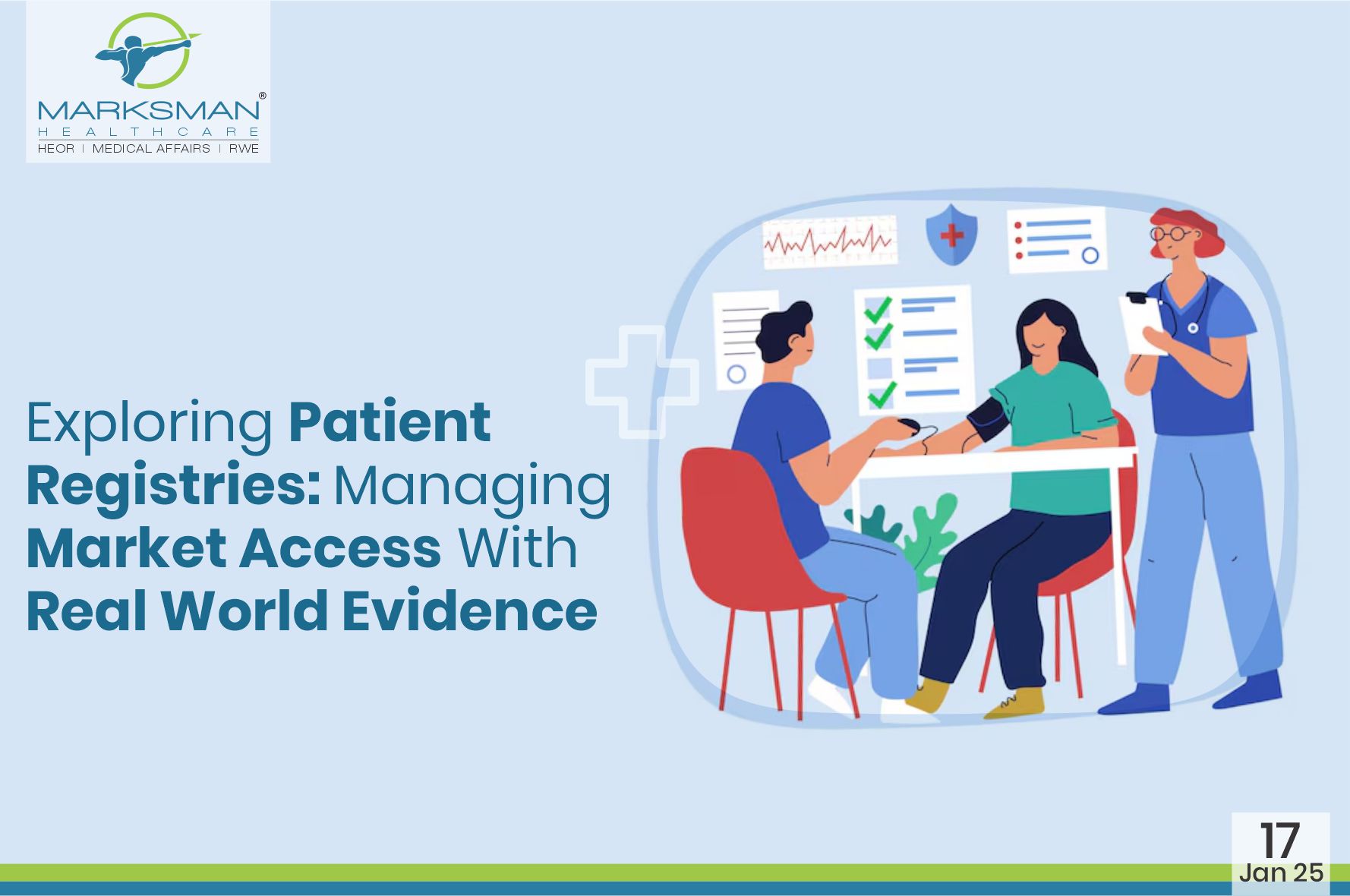

In the increasingly data-driven world of healthcare, patient registries have emerged as powerful tools for managing market access through the application of real-world evidence (RWE). These registries, essentially databases that collect information about patients’ demographics, clinical history, treatment outcomes, and other pertinent details, provide a treasure trove of insights that can bridge the gap between clinical trials and everyday medical practice. The use of patient registries in gathering RWE is transforming how pharmaceutical companies, healthcare providers, and policymakers evaluate and manage the accessibility and effectiveness of medical treatments and interventions.[1]
Patient registries provide a comprehensive view of how treatments perform outside the controlled environment of clinical trials. Clinical trials, while essential for establishing the efficacy and safety of new therapies, often have limitations, such as restrictive inclusion criteria and relatively short follow-up periods. In contrast, patient registries encompass a broader patient population, including those with comorbidities and varying adherence levels, thus reflecting real-world scenarios more accurately. This inclusivity makes registries a valuable source of RWE, which is increasingly recognized by regulatory agencies and payers as critical for assessing the long-term value and impact of medical interventions. Regulators also view the use of registries as a key tool for generating RWE, supporting decision-making processes across areas such as post-market surveillance, submissions for regulatory approval, and health technology assessments (HTAs).[1]
One of the primary benefits of utilizing patient registries is the ability to generate evidence on long-term safety and effectiveness of treatments. This ongoing evidence collection improves patient trust in the intervention, thereby increasing patient access. For instance, post-marketing surveillance through patient registries can uncover adverse effects or benefits that may not be apparent during pre-approval clinical trials. This continuous monitoring helps in ensuring that the treatments remain safe and effective once they are in widespread use, supporting regulatory decisions and guiding clinical practice. Consequently, this fosters greater confidence and willingness among patients to adopt new treatments, enhancing their accessibility and uptake in the general population.[2]
Patient registries also play a pivotal role in market access by demonstrating the value of new treatments to payers and health technology assessment (HTA) bodies. The data derived from these registries can support health economic evaluations, such as cost-effectiveness and budget impact analyses, which are essential for reimbursement decisions. By providing robust evidence on the real-world effectiveness and safety of treatments, registries help build a compelling case for their adoption and coverage. This is particularly important in an era where healthcare budgets are constrained, and there is increasing scrutiny over the allocation of resources.[3]
Despite their benefits, patient registries face challenges that must be acknowledged to provide a balanced perspective. Issues such as data quality inconsistencies, difficulties in patient recruitment, and regulatory hurdles can hinder their utility. For example, inconsistent data collection processes may impact the reliability of insights, and recruitment barriers can limit the diversity of patient populations within registries. Addressing these challenges requires standardizing methodologies, fostering collaboration among stakeholders, and ensuring compliance with evolving regulatory frameworks. Additionally, emerging trends such as the integration of digital health technologies and artificial intelligence (AI) are redefining the capabilities of patient registries. AI, for instance, can analyze large-scale registry data to identify patterns, predict treatment outcomes, and optimize resource allocation, enhancing the potential of RWE to inform decision-making.[4]
Collaboration among stakeholders is critical for the success of patient registry initiatives. Engaging a diverse group of participants, including patients, healthcare providers, researchers, and industry partners, ensures that registries are comprehensive and relevant. Leveraging technologies such as electronic health records (EHRs) and mobile health applications can streamline data collection, improve accuracy, and enhance data utility. These collaborative and technological advancements position registries as powerful tools for addressing unmet medical needs, optimizing healthcare delivery, and achieving equitable access to treatments.[4,5]
In conclusion, patient registries stand as pillars in the contemporary healthcare landscape, offering a bridge between clinical trials and real-world practice. Their role in managing market access through the application of RWE is indispensable, shaping how pharmaceuticals are evaluated, accessed, and integrated into healthcare systems. With their ability to capture the intricacies of patient experiences over time, these registries empower stakeholders to make informed decisions, driving advancements in healthcare delivery and ensuring that groundbreaking therapies reach those in need. By addressing challenges, embracing innovation, and fostering collaboration, patient registries will continue to play a transformative role in optimizing patient care and healthcare resource utilization.
Become A Certified HEOR Professional – Enrol yourself here!
References:
- Trotter JP. Patient registries: a new gold standard for “real world” research. Ochsner Journal. 2002 Sep 21;4(4):211-4.
- Reid CM. The role of clinical registries in monitoring drug safety and efficacy. Heart, Lung and Circulation. 2015 Nov 1;24(11):1049-52.
- Blommestein HM, Franken MG, Uyl-de Groot CA. A practical guide for using registry data to inform decisions about the cost effectiveness of new cancer drugs: lessons learned from the PHAROS registry. Pharmacoeconomics. 2015 Jun;33:551-60.
- Gliklich RE, Dreyer NA, Leavy MB. Patient registries. InRegistries for Evaluating Patient Outcomes: A User’s Guide [Internet]. 3rd edition 2014 Apr. Agency for Healthcare Research and Quality (US).
- Daugherty SE, Lee SB, Nowell B, Peay H, Solomon D, Valbrun TG, Velentgas P, Whicher D. The increasing focus on the patient in patient registries. In21st Century Patient Registries: Registries for Evaluating Patient Outcomes: A User’s Guide: 3rd Edition, Addendum 2018 Mar. Agency for Healthcare Research and Quality (US).

 Healthcare management is a combination of information science, computer science, information technology and healthcare. It incorporates resources, devices, and methods for optimising the acquisition, storage, retrieval, and use of data in health and biomedicine. This includes not only computers, but also clinical guidelines, medical terminologies as well as information and communication systems. Research and development efforts within the healthcare industry and ever increasing technological advancements over the last two decades have brought about momentous improvements in the quality of medical services to the patients. Developed countries are contributing a lot of resources in order to improve their healthcare systems as well as their integration with information technology. (1)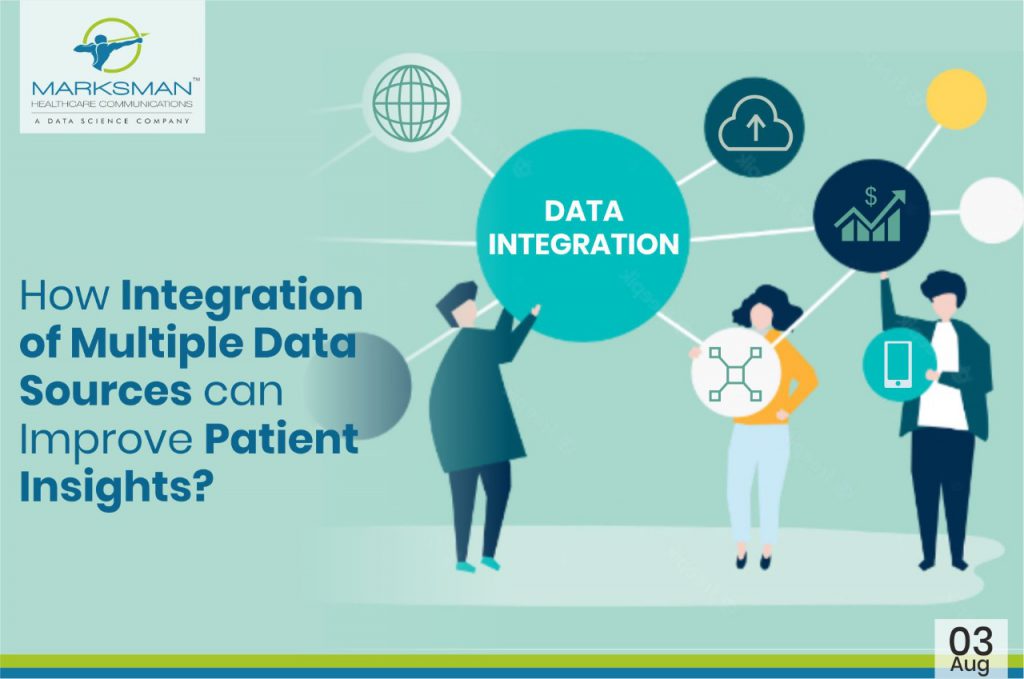
 There are humungous quantities of data existing in healthcare; data from all kinds of sources, such as clinical, patient, payer, R&D, pharmacy as well as revolutionary technologies that are being quickly embraced, for e.g. data from wearable devices. According to a report by International Data Corporation (IDC), (1) the volume of healthcare data which was observed to be around 153 exabytes in 2013 is estimated to reach around 2,314 exabytes in the year 2020. Therefore, integrating data from all types of diverse sources and clinical systems is a fundamental challenge for any healthcare entity in order to enhance patient care and performance indicators. (2)
 The concept of “Big Data” is #trending today, which is characterized by types of data sources with huge quantities, high speed and broad diversity of information. Healthcare industries are trying to apply Big Data analytics to reform data into a workable platform in order to generate information that would help making better and faster clinical decisions, such as reduced readmissions, scaling down hospital-associated illnesses, identifying and eliminating waste, improved clinician workflow etc. Government and the private sectors are taking in Big Data to enable better, quicker and more valuable care delivery to people. (1)
 There is heaps-full of data existing in the healthcare domain that has been generated historically, by means of record keeping, compliance & regulatory requirements, and patient care. (1) The current trend suggests faster digitization of this large amount of data, known as ‘Big Data’, that have been stored as hard copies over time. Big Data can facilitate a wide range of medical and healthcare functions, such as clinical decision support, disease surveillance, and population health management; with primary goals of providing better quality of healthcare delivery as well as reducing the costs. (2,3)
 Currently, the data protection law in India is facing many issues due to the absence of proper legislative framework. The theft and sale of stolen data is happening across vast continents, where physical boundaries pose no restriction in today’s technologically advanced era. India, being the largest host of outsourced data processing in the world, could become the hotbed of cyber crimes; mainly owing to the lack of appropriate legislation. (1)
 Traditionally, the pharmaceutical industry has always been dependent upon the ‘push’ strategy for successful market access for products. The drug approval process, involving submission of data on efficacy, safety, and tolerability to the regulatory agencies, used to be simple; which ended with the drug being marketed to the targeted physicians and dispensed by pharmacies post approval. Thus, this whole process involved a limited set of stakeholders, viz. physicians, regulatory agencies, and pharmacies. Conversely, over the years, the market access landscape has evolved primarily due to two factors: (1)
 Healthcare outcomes are defined as the changes observed and/or recorded in health status of individual or population patient/s usually due to an intervention, measures or specific healthcare investment. (1) The goal is to save the lives, shorten hospital stays and build healthier communities relying on preventative measures. (2) The fundamental steps of improving outcomes are measuring, reporting and analysing the outcomes. The efficient synthesis, organization and analysis of healthcare data offer the healthcare providers and other healthcare stakeholders with systematic and insightful treatment, measures and diagnosis. This may lead to higher patient care quality and better outcomes at lower costs.
 Missing data are a big concern in any research project and are often unavoidable in spite of investigators’ best efforts. Missing outcomes have two effects: reduced precision and power, and bias. Also, the loss of precision is inevitable, except the possible use of the available data; e.g. to be sure not to exclude from the analysis individuals who dropped out before the end of the study but who nevertheless reported intermediate values of the outcome. However, the statistician can aim to reduce bias through suitable choice of an analysis. (1)