

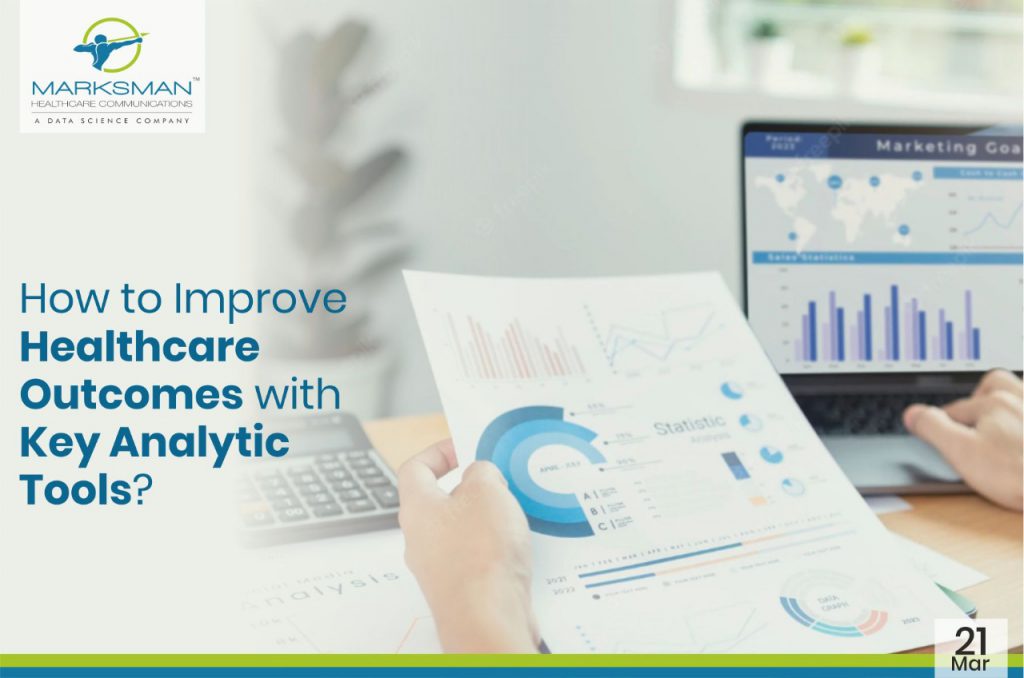
 Healthcare outcomes are defined as the changes observed and/or recorded in health status of individual or population patient/s usually due to an intervention, measures or specific healthcare investment. (1) The goal is to save the lives, shorten hospital stays and build healthier communities relying on preventative measures. (2) The fundamental steps of improving outcomes are measuring, reporting and analysing the outcomes. The efficient synthesis, organization and analysis of healthcare data offer the healthcare providers and other healthcare stakeholders with systematic and insightful treatment, measures and diagnosis. This may lead to higher patient care quality and better outcomes at lower costs.
Healthcare industries generate a huge amount of information known as ‘big data’, driven by record keeping, compliance and regulatory requirement, potential to improve healthcare deliveries, and digitalization of historic data. (3) It include the clinical data from hospitals, clinics, pharmacies, pathological laboratories, diagnostic/imaging reports, healthcare insurances, and administrative data; individual patient data in electronic patient records (EPR) during various phases of clinical trials; pre-clinical data; hospitalization frequency data; research articles and reviews in scientific and medical journal; and information from various healthcare data resources; social media posts on different platforms; and less patient-specific information such as emergency care, news feed and healthcare magazines. (4) As per reports the data of U.S. alone may reach 1024 gigabyte soon. (3) There is need of rapidly transforming the volumes of aggregated healthcare data to value-based healthcare.
The analysis and assessment of huge healthcare data can be performed using advance platforms and tools with ability to handle structured, semi-structured or unstructured data. The data from random sources need to connect, match, cleanse and prepared for processing using three main steps of extract, transform and load. (4) The key platforms and tools to handle ‘big data’ are the Hadoop Distributed File System, MapReduce, PIG and PIG Latin, Hive, Jaql, Zookeeper, HBase, Cassandra, Oozie, Lucene, Avro, Mahout. (3) The analytic tools combine knowledge and data driven insights for identifying risks-factor and augmentation. These analytic tools have important applications for queries, reports, online analytical processing (OLAP) and data mining. (3) These analytic tools can search and analyse massive quantity of information from past treatments, latest published researches and healthcare databases to predict outcomes for individual patient. (5)
Data analytic tools benefit all the components of healthcare system to improve healthcare outcomes. These components are healthcare service providers, patients, payers, stakeholders and managements. (6) Healthcare providers can develop new strategies and plan to care for patients such as reduce unnecessary hospitalizations and expenses. The patients at greatest risk of readmission can be identified and get guidance on follow ups for efficient resource utilization to save a huge amount of money spent each year on unnecessary hospitalization.
The time gap always exists between a clinical event and the information to reach healthcare decision makers which could have bring the positive outcomes. The near real-time health surveillance can be performed using the information from social media blogs, micro-blogging on social networking sites such as Twitter and Facebook, and newspaper articles. (7) These social media networks provide information on the current locations by geo-tagged alerts. Real time analytic tools bring together the disparate information from various resources to the point of patient care, where the benefit can really be life-saving. It offers healthcare system access the most up-to date information. It realigns task based on priorities of healthcare providers, stakeholders, and insurers to improve healthcare outcomes. It addresses the gaps in care, quality, risk, utilization and regulatory requirement to support the improvements in clinical and quality outcomes; and financial performances. It provides a real-time report stating the real healthcare status of a patient and suggestions on improvement of the quality, achievement of compliance and realization of full reimbursement for their services. (8)
It is often difficult for patients and clinician to keep the track of various healthcare organization-specific programs. The analytic tools may provide clinicians the information on a right program an eligible patient may enrol at a right time to help improve care and decrease costs. (8) The healthcare providers can assess patient-specific eligibility, gaps in care, risk scores, and historical medical information at the point of care which can be easily integrated into their existing operational model.
The analytic tools improve healthcare outcomes by reducing the efforts and time required to handle ‘big data’ and conversion of volume to value-based information. These tools help encourage quality care to the patients benefitting payers as well as investors. The analytic tools would significantly support the advancement of medical and health science.
Become an Certified HEOR Professional – Enrol yourself here!
References
- Velentgas P., Dreyer N.A., and Wu W. A. (eds) Outcome Definition and Measurement. In ‘Developing a Protocol for Observational Comparative Effectiveness research: A User’s Guide’. Rockville,MD: Agency for Healthcare Research and Quality; AHRQ Publication No. 12(13)-EHC099, 2013.
- Kumar P. How real time analytics improves outcomes in healthcare. Published online on ‘IBM Cloud Blog’ dated June 19, 2017.
- Raghupathi W. and Raghupathi V. (2014). Big data analytics in healthcare: promise and potential. Health Information Science and Systems 2, 3
- Gandomi A., and Haider M. (2015). Beyond the hype: Big data concepts, methods, and analytics. International Journal of information Management 35, 137-144.
- Winters-Miner L.A. (2014) Seven ways predictive analytics can improve healthcare. Medical predictive analytics have the potential to revolutionize healthcare around the world. Published online on ‘Elsevier’s Daily stories for the science, Technology and health communities’ on Oct 06, 2014.
- Sun J. and Reddy C.K. (2013). Big data analytics for healthcare. Published in ‘KDD 2013 Proceedings of the 19th ACM SIAM International Conference on Knowledge Discovery and Data Mining’ held at Austin, TX, pg 1525-1525.
- Lee K., Agrawal A., and Choudhary A. (2013) Real-time disease surveillance using Twitter data: demonstration on flu and cancer. Published in ‘KDD 2013 proceedings of the 19th ACM SIGKDD international conference on knowledge discovery and data mining’, held at Chicago, Illinois, USA, pg 1474-1477.
- Rizzo D. The power of real-time analytics at the point of care. Published online on ‘Health IT Outcomes: Guest Column’ dated Dec 14, 2015.
 ‘Patient’ should be considered as the centre for any healthcare system. There is growing realization for the patient-centered healthcare system. The outcomes of a clinical intervention obtained by the patient i.e. patient-reported outcomes (PROs) seemed to be of more importance in coming years than any other outcomes like clinical, physiological or caregiver-reported. The US Food and Drug Administration (USFDA) defines PRO as any report of the status of a patient’s health condition that comes directly from the patient, without interpretation of the patient’s response by a clinician or anyone else.